

The Surprising Parallels Between America's Greatest Architect and Its Most Iconic Technologist This...
Ten years as a docent and what Wright’s most complete Prairie interior reveals about the way we make things.
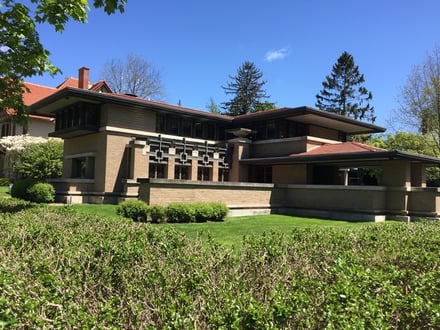 Someone vouched for me. That is how most worthwhile things begin. In 2015, a friend who was already a docent at the Frank Lloyd Wright Meyer May House in Grand Rapids recommended that I apply for the incoming class. I was not a trained architect. What I was—and had been for as long as I could remember—was someone drawn to architecture and to the unconventional: to buildings and objects that refused to do things the expected way, that carried a point of view in every line. I was also someone who had spent years thinking seriously about how things are made, about mechanical systems, and about the rare designs that achieve beauty and function so completely that the two become impossible to separate. Wright, I already understood, was exactly that kind of maker. I applied. I was accepted. And I have not looked at a room or house the same way since.
In the years since, I have given more than 250 tours of the house, to members of the public, to professional architects, to industrial designers, to business executives visiting as guests of Steelcase, which purchased the home in 1985, spent six months in research, and then conducted a thorough restoration of every original detail before opening the house to the public in the fall of 1987. That patience and planning—the decision to study before acting—is itself very Wright. He would have approved. Then again, Wright would certainly have notes. He always did. Lots of them!
The house still stops people mid-threshold. Not every building does that.
Wright did not just design rooms. He choreographed lived experiences, and he did it with a precision and attention to detail that most designers never approach, because he refused to treat any element of a project as someone else’s problem.
The Meyer May House was commissioned in 1908 for Meyer and Sophie May. Meyer May was a prominent Grand Rapids clothier; Sophie was, among other things, a notable member of the Ladies Literary Club, a Grand Rapids institution whose affluent, well-connected membership was active in advocating for women’s rights and suffrage. This was not a household defined by convention. Wright, who never designed conventionally, was a fitting choice. The family moved into the home two years later, in 1910. It is a Prairie-style home: low, horizontal, deeply connected to the earth it sits on. From the street, it announces itself not by towing over the neighborhood like those that surround it. Rather, the Meyer May House stands out by trying desperately to blend into the natural surroundings of the Midwest prairie landscape. But the architecture is not the first thing that stops people mid-tour. The first thing that stops them is realizing that Wright designed nearly everything in it.
How Frank Lloyd Wright Designed Every Detail
Not just the structure. The art glass windows are perhaps the most immediate expression of this — their geometric patterns composed to filter and shape light in specific ways at specific times of day. But look more closely and something else emerges: a motif, abstracted from the blade of a wheat stalk, that Wright carried through the entire interior as a kind of visual grammar. It appears in the leaded art glass, yes — but then it reappears in the grates of the wall sconces, where it filters light onto the plaster in the same pattern it casts through the windows. It appears again beneath the feet, in the carpets. And it appears in Wright’s own furniture design drawings, woven into the table runners. The same form, at every scale, in every material, in every layer of the room. That is not mere decoration. That is a total integrated design language—a single sentence spoken simultaneously by the floor, the walls, the light, and the table.
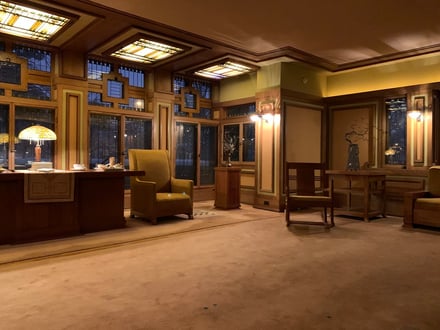 The furniture and the proportions of the entire house carry this precision even further. Wright designed the home to the specific stature of Meyer May himself—five feet, four inches—so that every horizontal element, every sight line, every surface would make the man who lived there feel, in his own home, like a giant. Standing in the living room at 5’10”, I can feel exactly what Wright intended: the oak window band sits directly at my eye level, impeding my view out the window. But the house wasn't built for me. For Meyer May, that same band would have cleared above his head, opening the room upward and outward in a way that made him feel expansive rather than enclosed. This was not a generic human-scale design philosophy. It was a bespoke gift, built in oak and glass, to one specific man’s sense of himself in space.
Then there is the matter of the windows. The house contains 116 of them—and nearly all are concentrated on just three of the four sides. That is not an oversight or accident. It is a solution. Immediately to the north sat a substantial English Tudor home belonging to the Wallen family—an architectural statement of an entirely different kind, and one Wright had no interest in forcing the Mays to look at daily. Equally important, he had no intention of giving the Wallens a clear view into the May house. So he turned the windows away, massing them on the three sides that served the Mays and withholding them on the north. The north wall closes. The rest of the house opens.
This matters especially because Wright had a deep aversion to window coverings. Curtains and shades were, to him, an insult to two things he cared about most: the unmediated presence of the natural world and the integrity of his art glass. A window covering is an admission that the design has failed to solve a problem that should have been solved in the architecture. At the Meyer May House, he solved it in the architecture.
Wright could not tell the Mays to draw the curtains. So he designed a house that never needed them—and turned 116 windows into an argument about what it means to truly control a space.
This is what I mean when I say nothing was an accident. Wright operated at a scale of intentionality that is genuinely difficult to absorb on a first visit. You think you are looking at a house. You are actually looking at a unified argument about how human beings should inhabit space—one made in wood, glass, brick, and oak trim, right down to the alignment and design of the north wall of the home.
The Frank Lloyd Wright Details Most Visitors Miss
I tell people, when they ask what changes about a building after you have stood in it over 250 times, that the building does not change—you do. The details you could not see on a first visit become visible. The relationships between elements sharpen. You begin to notice the wheat motif moving through the room like a recurring phrase in a piece of music—first in the glass above you, then in the light on the wall beside you, then in the pattern beneath your feet. You begin to understand why a threshold is placed where it is, why the ceiling molding takes a particular path at precisely that moment in a sequence of rooms, why the windows cluster on some walls and vanish on others. And you begin to feel, even at your own height, the ghost of the man this house was built around—the specific, particular, five-foot-four-inch human being Wright decided deserved to feel like a giant in his own home.
What also changes is the nature of the conversations. Architects ask different questions than executives. Designers see different things than first-time visitors who wandered in off the street after finding the house on TripAdvisor. But the question that transcends every audience—the one that lands in every room, every time—is some version of: how did one person hold all of this in his head at once? And then, one beat further: what else did he hold that we will never be able to see?
Those are fair questions. They are, I think, the right questions. And they are ones I intend to spend several more essays trying to answer.
This is the first post in an ongoing collection on Frank Lloyd Wright—his architecture, his philosophy, and his lasting influence on the way we think about design, creativity, and craft. Future posts will explore the Meyer May House in closer detail, Wright’s relationship with the natural world, and an argument I have been developing for years: that Wright and Steve Jobs were, in the most essential ways, the same kind of mind.